
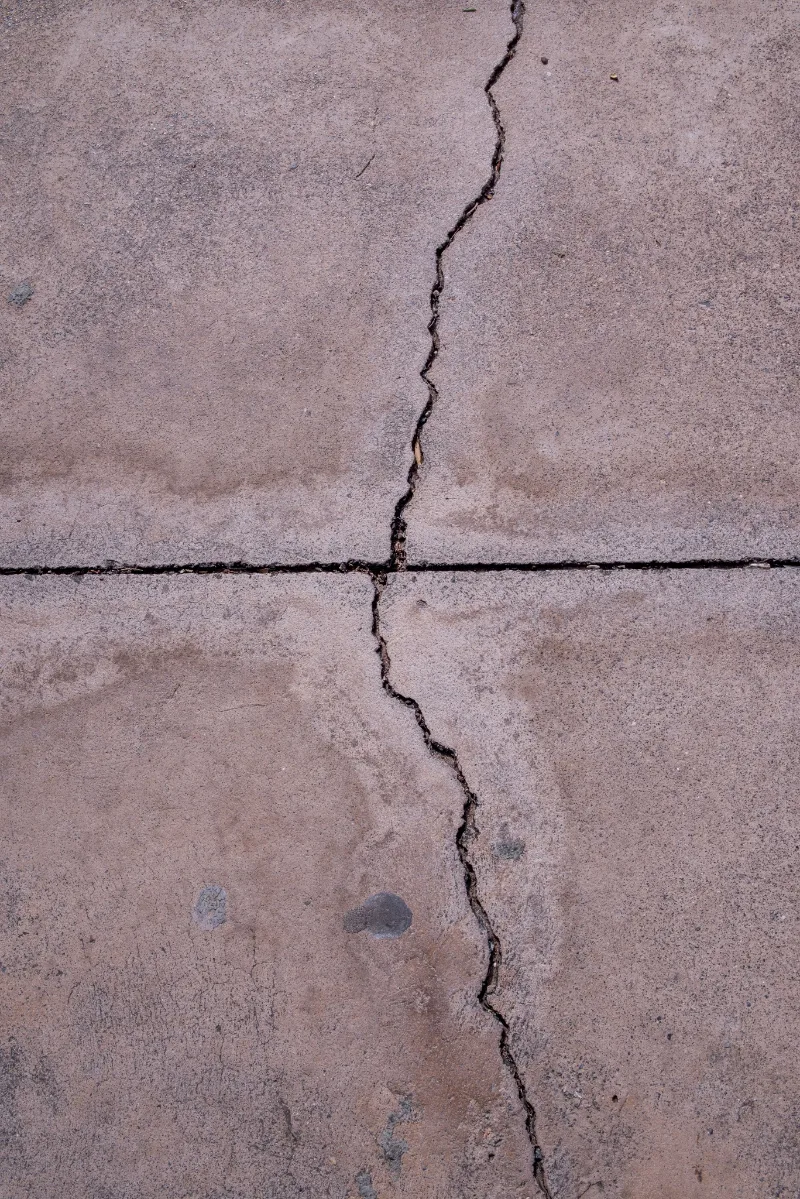
On a sound slab that has settled, leveling is cheaper than replacement and it is not close. Most of the gap is not the concrete, it is the tear-out.
That answer stops being true the moment the slab itself has failed. Lifting a driveway that is crumbling gets you a level driveway that is still crumbling, and you pay twice. So the useful question is not which repair is cheaper. It is which one your slab actually needs, and you can sort that yourself in about 10 minutes.
What each one actually costs
Here are both columns, with the lines a quote usually leaves out.
| Line item | Typical cost |
|---|---|
| New concrete, materials and labor | $6 to $15 per sq ft |
| Removing and disposing of the old slab | $3 to $8 per sq ft |
| Removal permit, where required | $50 to $400 |
| Install permit | $50 to $200 |
| Cutting contractor minimum | $125 to $400 |
| Downtime before normal use | 7 days or more |
| Leveling, mudjacking | $4 to $9 per sq ft |
| Leveling, polyurethane foam | $8 to $25 per sq ft |
| Downtime after leveling | usually same day |
The clearest proof of the point comes from one publisher pricing the same concrete twice. A new sidewalk is quoted at $7 to $17 per square foot installed. Replacing an existing sidewalk is quoted at $10 to $25 per square foot. Same walk, same finish, same crew. The difference between those two numbers is the old concrete leaving the property.
Published data puts mudjacking at 30% to 50% less than tearing out and replacing. That matches what I see, and on driveways the spread is usually wider than that, because a driveway is heavy and hauling it away is priced by weight.
For the full grid by method and by slab, see what leveling costs per square foot.
The sorting test: four things to look at on your own slab
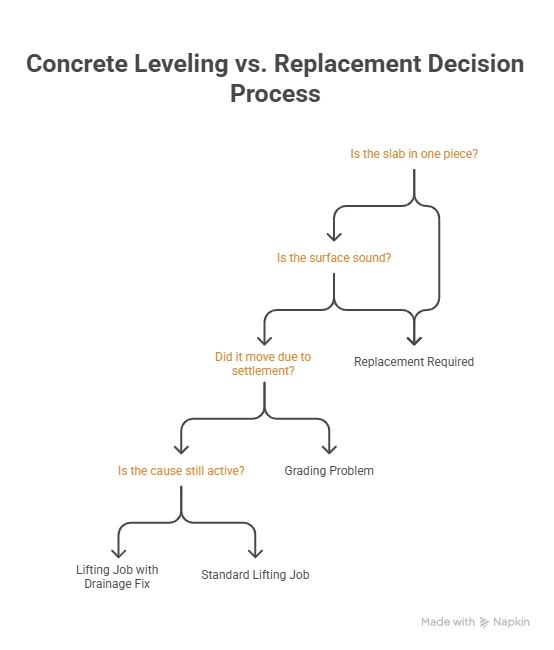
This is what I do on an estimate, and there is nothing stopping you doing it before I get there. Four questions, in order. A no on any of the first three usually ends it.
Is the slab still in one piece?
Walk it and count the pieces per section. A panel with a crack or two through it still lifts, because it is still acting like a slab. A panel broken into several pieces has stopped being a slab and started being a pile, and pumping material under a pile just rearranges it.
Is the surface still sound?
Run a hand over it. Sound concrete feels solid and stays put. If it sheds grit, if the top layer is flaking away, if edges crumble when you press them, the concrete is worn out. Lifting restores where the slab sits. It does not restore concrete that is worn out. That sentence decides more jobs than any other in this trade.
Did it move, or was it always like that?
Settlement leaves evidence, because something next to it stayed put. A stoop that has dropped away from the door threshold. An apron sitting below the garage floor. A patio that has pulled down from the siding and opened a gap. Look for the reference that did not move. If nothing has separated and the slab has simply always drained the wrong way, that is a grading problem from the original pour, not settlement, and lifting is a poor fix for it.
Is whatever caused it still working?
Two things make a repair temporary regardless of method. A root that is still growing will lift the slab again on its own schedule. A live water source, a downspout emptying beside the concrete, a sump line running under it, an open joint nobody has resealed, will keep washing the base out from under whatever we put there.
If the first three say lift and the fourth says there is water to deal with, that is still a lifting job. It is just a lifting job with a cheap drainage fix attached, and the drainage part is usually something you can do yourself. If you want the surface itself dealt with, that is concrete repair and it is a separate conversation.
What a replacement quote leaves out
Replacement quotes are usually honest. They are just quoting the part the contractor is thinking about, which is the pour. I have read a lot of them across kitchen tables in this metro, and these are the lines I look for first.
Removal and disposal. Current figures put this at $3 to $8 per square foot including disposal, with driveway removal alone landing at $1,200 to $4,500. Dump fees run $90 to $160 per ton. Concrete is heavy, and a driveway is several tons of it.
Permits, plural. A removal permit runs $50 to $400 depending on the job, and most residential driveway installs need a permit of their own at $50 to $200. Confirming what your project needs is on you as the property owner, not on the contractor, and it is worth a phone call to the city before anybody starts.
Access and mobilisation. Cutting contractors carry minimums of $125 to $400. On a small job that is most of the bill.
What happens to the rest of your property. A tear-out means a machine on your driveway, a truck at the curb, and a load of broken concrete crossing whatever is between the slab and the street.
Ask for tear-out and disposal broken out as their own line. If a quote will not separate them, you cannot compare it to anything.
The seven days you cannot park on it
This is the column nobody prices, and for a driveway it is the one people feel.
New concrete needs about seven days before you can drive and park a car on it, at which point it has reached roughly 70% of its potential strength. You wait at least 24 hours before walking on it. Anything heavy, an RV, a loaded truck, waits 28 days.
A lift is different. Most areas are back in use the same day. Foam cures in about 15 minutes and slurry wants roughly a day before vehicle weight, which is still six days better than a pour.
For a household with two cars and no street parking, a week is not a footnote. It is the reason people put off a repair they already know they need. I have had customers tell me the downtime, not the money, is what kept them from calling a replacement contractor two years earlier.
The third option most people never hear about
Not everything is lift or replace.
If your concrete is level but ugly, if the surface is flaking and pitting and the panels are still sitting where they belong, what you are looking at is probably scaling. The ready-mix industry defines it as flaking or peeling of the finished surface caused by freezing and thawing, and names the usual culprits: too little entrained air in the original mix, heavy calcium or sodium chloride de-icer on concrete that was not strong enough or cured long enough, and finishing while bleed water was still on the surface.
That is a surface problem. The standard answer is to remove the unsound material and resurface, with one honest warning attached: a repaired surface is only ever as strong as what it is bonded to.
I get called to lift a fair number of slabs that never settled. The owner is looking at a driveway that looks terrible and assumes something has moved underneath. Nothing has. The base is fine and the top 3/8 of an inch is gone. That is not my job, and I tell them so. If you want the difference laid out properly, we covered it in resurfacing.
When replacement is genuinely the right call
I lift concrete for a living and I still tell people to replace concrete most weeks.
A slab broken into many pieces goes. Concrete crumbling from years of de-icer goes, because you cannot lift your way to a new surface. A slab at the end of its service life goes, and a driveway is generally reckoned to last 30 years with maintenance, longer if it was poured well. Active growing roots go, or at least the root gets dealt with first, because lifting over one is scheduling your own callback.
Then there is the case nobody likes: sometimes the numbers are just close. Minimum charges do not scale down, and jobs under 25 square feet often carry a trip minimum on top of that. On a small stoop the two options can land within a few hundred dollars of each other, and at that point the right answer is whichever one you would rather live with.
Lifting is not always the right answer, and contractors who will not say that are doing their customers wrong. When replacement is the better value we will tell you that rather than sell you a repair that buys two seasons.
The flip side is the reason I do this work. A woman called me about a front entry stoop that had dropped on the outside edge. Two contractors had told her to tear it out. It was a separate pour from the house, with a void underneath from 15 years of backfill movement and roof water, and the concrete itself was still sound. We drilled ports, pumped slurry slowly on the low side, brought it up in stages and patched the holes. Two hours. She paid roughly 20% of the replacement quote.
Two contractors ran the same job through the same decision and got it wrong, because they only sell one of the two answers.
Cost per year, and why it is not a clean comparison
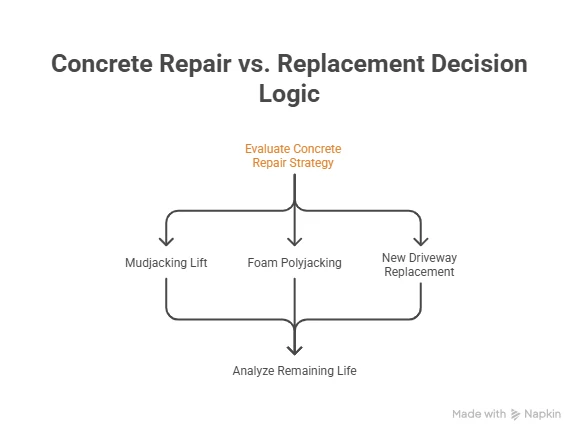
You will see this comparison made and it is worth understanding why it does not settle anything.
Published lifespans put a mudjacking lift at 5 to 10 years or longer and foam at 10 to 15, both conditional on soil and drainage. A new driveway is quoted at up to 30 years. Divide cost by years and replacement starts looking respectable.
The problem is that those numbers are not measuring the same thing. A replacement restarts the clock on concrete that is brand new. A lift buys years on concrete that already has 20 or 30 years on it and will reach the end of its life on its own schedule regardless. You are not choosing between 8 years and 30. You are choosing between spending a little now on concrete that still has life in it, or spending a lot now to get life you may not need.
And a lift lasts as long as the conditions under the slab allow. If the water that made the void is still running, the number of years in that division is smaller than any figure above, and it does not matter which option you bought. I would rather have that conversation before the work than after it, so it gets its own page: how long a lift actually lasts, with what two state agencies found when they went back and measured.
What Omaha's code decides for you
If the concrete in question is your public sidewalk, the city has already written a sorting test and it is worth reading as a budget document.
Under Omaha Municipal Code sections 26-41 through 26-44 the property owner is responsible for repairing the abutting walk. The published defect thresholds are: faulted at a joint or crack with 1 inch or more of deflection, raised or sunken more than 2 inches in 8 feet from the normal profile, cracked into three or more pieces per panel, any single crack with a half inch or greater opening, or cracking with spalling deeper than 3/8 inch.
Look at how that list splits. The first two are settlement, and settlement lifts. The last three are condition, and condition does not. The city drew the same line I do.
If you do not act on a notice the city's contractor performs the work and bills you, with 30 days from the billing date to pay, and at that point you are not choosing between two repairs. You are receiving an invoice for the expensive one.
For context on where a lip becomes a hazard rather than an annoyance, the federal standard allows a quarter inch of vertical change untreated and up to a half inch if it is beveled. Anything more has to be treated as a ramp.
We are not attorneys, and responsibility varies. Confirm your own obligation with the city before you spend anything.
Two things to do before you accept a replacement quote
Get the tear-out itemised. Removal and disposal is a third of the job on some slabs. If it is buried in a single number you cannot compare that quote to a repair, or to another quote.
Get an opinion from somebody who does not pour concrete. A contractor who only replaces has one recommendation available to him. That does not make him dishonest, it makes him limited, and the limitation costs you money. I will say the same thing about myself: get a second look before you take my word for it either.
Finding out which one your slab needs
The sorting test above is what an estimate is, done properly. We walk the concrete together, I show you what actually moved and by how much, and you get a straight answer about whether lifting is the right call, which method fits, and what the work will realistically accomplish. If replacement is the honest answer you hear it from me on site.
Free, on site, no obligation, and same-day response is typical. Call or text (402) 625-4920.
We cover Omaha, Bellevue, Papillion, La Vista, Ralston, Council Bluffs, Gretna and Bennington, including concrete lifting on everything from a front step to a full driveway.
FAQ
Is concrete leveling cheaper than replacing the slab?
For a sound slab that has settled, yes, and by more than most comparisons show. Published data puts mudjacking at 30% to 50% below tear-out and replacement, and that gap widens once you add the removal permit, the disposal fees and the week you cannot use the surface. On a slab that has actually failed, leveling is not cheaper, it is wasted.
When should concrete be replaced instead of lifted?
When the slab is broken into several pieces, when the surface is spalling or crumbling from de-icer, when the concrete has reached the end of its service life, or when an active growing root is the cause. Raising a slab restores its position. It does not restore concrete that is worn out.
How much does it cost to tear out and replace concrete?
Removal and disposal run $3 to $8 per square foot on their own, with driveway removal at $1,200 to $4,500. The new pour is another $6 to $15 per square foot for standard finishes, plus permits. Those are market ranges, not our quote. We price on site.
How long before you can drive on new concrete?
About seven days for a car, when the concrete has reached roughly 70% of its strength, and 28 days before anything heavy. You can walk on it after 24 hours. A lifted slab is usually back in service the same day.
Does leveling work on cracked concrete?
It depends on the crack. A panel with one or two cracks that is still holding together lifts fine, and the crack stays where it was. A panel broken into several pieces does not, because there is nothing left to lift as a unit. We will tell you which one you have at the estimate.
Who decides whether my sidewalk has to be replaced in Omaha?
The city publishes defect thresholds and the property owner is responsible for the abutting walk under Municipal Code sections 26-41 through 26-44. Settlement-type defects can usually be lifted. Condition-type defects, spalling and panels broken into pieces, cannot. We are not attorneys, so confirm your own situation with the city.