
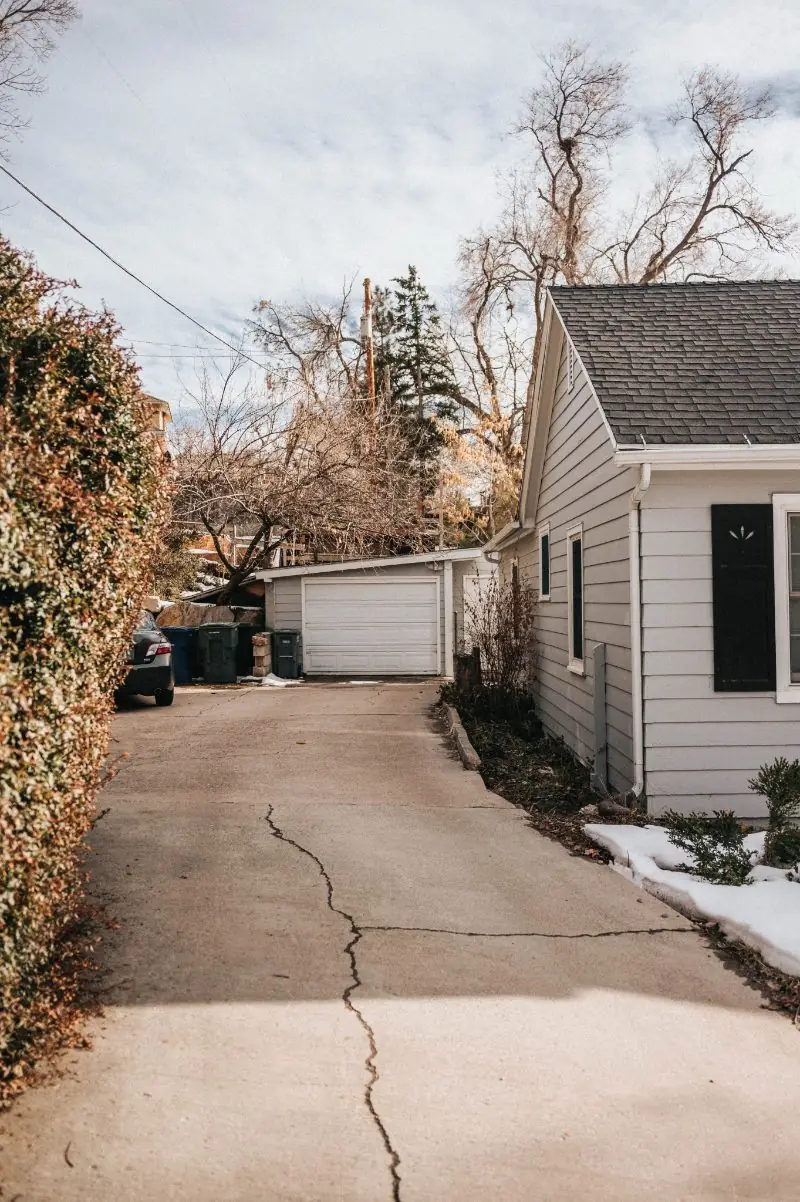
Mudjacking in this market runs roughly $4 to $9 per square foot. Polyurethane foam runs roughly $8 to $25. Those are the working numbers for 2026, and I will stand behind them as ranges.
I will not pretend the range is narrower than it is. I have walked slabs where the low end was right and slabs 20 feet away where the high end was right. The reason is not square footage. It is what is missing underneath.
What concrete leveling costs per square foot in Omaha
Here is the grid. These are published national ranges for 2026, and they hold up against what I see across the Omaha metro.
Cost by method
| Method | Typical range per square foot |
|---|---|
| Self-leveling compound | $2 to $5 |
| Mudjacking, cement slurry | $4 to $9 |
| Stone slurry grout | $6 to $15 |
| Polyurethane foam | $8 to $25 |
Cost by slab
| Slab | Size used | Mudjacking | Foam |
|---|---|---|---|
| Steps or stoop | 40 sq ft | $300 to $700 | $320 to $1,000 |
| Sidewalk | 100 sq ft | $400 to $900 | $800 to $2,500 |
| Patio or porch | 150 sq ft | $600 to $1,400 | $1,200 to $3,800 |
| Pool deck | 400 sq ft | not recommended | $3,200 to $10,000 |
| Garage floor | 360 sq ft | not recommended | $2,900 to $9,000 |
| Driveway | 450 sq ft | $1,800 to $4,100 | $3,600 to $11,300 |
Those figures come from 2026 cost data compiled across contractors nationally. Most of my Omaha jobs land in the lower half of each band, because most residential settlement here is 1 to 3 inches rather than 6.
Two rows say not recommended, and that is a scope note rather than a price note. We use foam on garage floors and pool decks because slurry adds weight to a base that is already soft, and near a pool shell that weight is a risk nobody needs to take.
Why two national price databases disagree by a factor of five
One 2026 guide puts foam at $8 to $25 per square foot. Another puts it at $5 to $25. Close enough. Then look at a pool deck. The second source prices one at $300 to $600. The first prices 400 square feet of pool deck at $1,600 to $3,600 for slurry alone.
That is not a rounding difference. One source is describing two panels touched up and the other a full deck.
I get asked for a phone price most days of the week and this is why I do not give one. There is no honest price I can give you without seeing the void and where the water is coming from. Neither is visible from a description, and neither shows up in square footage.
The four things that actually set your price
Void depth. The empty space under the slab is what we are filling. A slab sitting 1 inch low might have 4 inches of washout underneath. Material volume is the biggest line item on most jobs and you cannot see it from the top.
Lift height. Raising a panel a half inch and raising it 3 inches are different jobs. The taller lift takes more material, more time and more care, because concrete that comes up too fast cracks.
Access. A driveway I can back a rig up to prices differently than a back patio behind a locked gate. Hose runs and hand-carrying material cost time.
Method. Foam cures in about 15 minutes and costs more per square foot. Slurry costs less and needs roughly 24 hours before vehicles. The higher rate buys weight, speed and hole size, not a better repair by default.
When I walk a slab I am reading those four things. I look at the joints, I look at where water has been running, and I tap for hollow spots. I have been at this 20 years. I usually know within a few minutes whether lifting is the right call.
Mudjacking or foam, and what each one costs you
Mudjacking. Cement based slurry through larger holes, $4 to $9 per square foot. Costs less, adds weight, bigger patches, about a day before you park on it.
Polyurethane foam. Expanding foam through small holes, $8 to $25 per square foot. Weighs almost nothing, cures in minutes, vehicles back the same day, and the per foot rate climbs hard on small jobs.
That is the price difference. Which one your slab actually needs is a longer answer and it is not a cost question, so I put it on its own page: mudjacking vs. polyurethane foam, with the weights, the hole sizes and the four things I sort it by.
The small job problem nobody prices honestly
Most contractors carry a minimum. Published data puts it at $300 to $700 regardless of job size, and one national source lists a $150 trip minimum on anything under 25 square feet.
Run the math. A 30 square foot stoop at a $400 minimum is not $8 per square foot, it is over $13. The rate on a cost page assumes a job big enough to spread the mobilization across.
I still take small jobs, because a trip hazard at a front step is worth fixing. What I tell people is to look around the property first. If the stoop is low, the walk beside it has a lip and the garage apron is tipping in, that is one visit instead of three and the per foot number drops on all of it.
Leveling versus replacement, priced honestly
Most comparisons put leveling against the price of a new pour. That is not the real comparison, because you cannot pour until the old slab is gone, and removal and disposal run $3 to $8 per square foot on their own before a yard of new concrete is ordered.
Lifting is normally a fraction of what removal and replacement costs. That is arithmetic, not a slogan, and the tear-out line is where most of the gap lives. The full stack, both columns with the permits and the downtime, is laid out in leveling versus replacement.
A homeowner called me with a city notice in her hand. Her driveway apron was out of level and pushing water at the curb cut, and she had a quote for full apron replacement over $4,000. I walked it. The concrete was sound, no structural failure, the front 6 feet had simply dropped as the soil settled toward the street. We mudjacked that section back to grade and it passed inspection for a fraction of the replacement quote.
She was one signature away from a tear-out she did not need.
Cost per year is the number that matters
Divide the job by the years it holds and the cheap method is not always the cheap method.
Published lifespans put mudjacking at 5 to 10 years or longer and foam at 10 to 15, both conditional on soil and drainage. Take a 450 square foot driveway: slurry at $2,500 over 8 years is about $310 a year, foam at $5,000 over 12 years is about $417.
Now the caveat that breaks the math. A lift lasts as long as the conditions under the slab allow, so if the water that made the void is still running, the years in that division are fewer than either figure and the method you bought does not matter. I go through that properly in how long a lift actually lasts, with what two state agencies found when they went back and measured.
Dealing with the water source is what turns a repair into a lasting one, and most of it is cheap enough to do yourself. I point out what I see at every estimate whether or not I get paid for it.
What Omaha's sidewalk code does to your budget
Omaha holds the property owner responsible for the walk abutting their property, and the city's own defect thresholds double as a budget document: a panel faulted at a joint is still a lifting job, a panel broken into pieces is a tear-out. I have written the whole thing up, thresholds, notices and per panel pricing, in what it costs to repair a sunken sidewalk.
Why Omaha slabs settle in the first place
Omaha sits on expansive clay and the ground goes through a freeze thaw cycle every winter. Clay swells wet and shrinks dry, and concrete on top of it moves with it.
The bigger factor on most residential jobs is how the slab was built. Your house sits on footings below the frost line, roughly 3.5 feet down. Your patio sits on backfill. That backfill is the loosest ground on the property and it keeps compacting for years. The house stays put. The patio drops. That is not a mystery, it is just how it was built.
Water is the accelerator behind almost all of it. It moves the fine material out from under a slab and you end up with a void, and once there is a void the slab has nothing left to sit on.
The pattern changes by neighborhood and after 20 years driving this metro I can usually guess before I get out of the truck. Dundee walks are older concrete with mature roots underneath. Millard and Elkhorn driveways sit on fill still consolidating. Same repair, different reasons, sometimes different prices.
When leveling is the wrong thing to spend money on
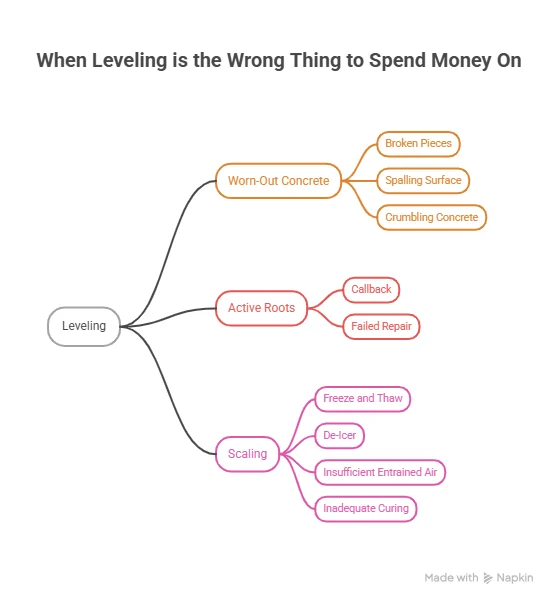
Raising a slab restores its position. It does not restore concrete that is worn out.
If the slab is broken into many pieces, if the surface is spalling and crumbling from years of de-icer, if the concrete has reached the end of its service life, lifting puts a sound-looking slab on a bad surface and you spend the money twice. Active roots are the other one. Lift over a root that is still growing and you are scheduling your own callback.
Lifting is not always the right answer and contractors who will not say that are doing their customers wrong. I would rather tell you at the estimate than take your money on a repair that fails next year.
There is a third category people miss, and it saves money in the other direction. A slab that is level but ugly has usually not settled at all. The ready-mix industry calls that scaling, flaking of the finished surface from freeze and thaw, driven by too little entrained air and by heavy de-icer on concrete that was not cured long enough. Surface problem, surface answer.
I get called out to a fair number of those. Nothing has moved, the base is fine, the top 3/8 of an inch is gone, and I say so rather than sell a lift nobody needs.
Two things to do before you accept any leveling quote
Get more than one estimate. I am telling you to get a competing number on my own page and I mean it. On a repair this variable, one price tells you nothing.
Walk away from any quote that never mentions the water. If nobody asked where your downspouts discharge, they priced the symptom. The water is the repair.
Getting a real number for your slab
We do not quote over the phone because the void under the slab and the water source causing it are the two things that actually drive the work, and neither is visible from a description.
What I do instead is walk the concrete with you. I show you what actually moved and by how much, which method fits, and what the work will realistically accomplish. If replacement is the honest answer you hear it from me on site, not after you have paid for a lift. Free, no obligation, same day response is typical.
Call or text (402) 625-4920. We cover Omaha, Bellevue, Papillion, La Vista, Ralston, Council Bluffs, Gretna and Bennington, including driveway leveling and every other kind of settled flatwork on a residential property.
FAQ
How much does it cost to level concrete in Omaha?
Mudjacking typically runs $4 to $9 per square foot and foam typically runs $8 to $25, with most contractors carrying a $300 to $700 minimum on small jobs. Your number depends on slab size, how far it has to be raised, site access and which method fits. Lifting is normally well below replacement cost for the same area. We quote on site only.
Is mudjacking cheaper than foam?
Per square foot, usually yes. Slurry runs roughly half the rate of foam. That does not make it the cheaper choice on every job, because foam is the right call on garage floors, pool decks and soft subgrade, and using slurry there creates a bigger problem than it solves.
Is concrete leveling cheaper than replacing the slab?
For a sound slab that has settled, yes, and the gap is wider than most comparisons show. Replacement is $6 to $15 per square foot for the new pour plus $3 to $8 per square foot to remove and dispose of the old concrete, plus permit and cure time. Leveling skips all of the removal.
How long does concrete leveling last?
It depends on why the slab settled. Published lifespans put mudjacking at 5 to 10 years or longer and foam at 10 to 15 years or longer, but a lift lasts as long as the conditions under the slab allow. If the void is filled and the water source addressed, the correction holds well. If water is still washing material out, it moves again regardless of method.
Can concrete be leveled during a Nebraska winter?
Foam handles cold better than slurry. The bigger complication is frozen ground and frost heave, which makes accurate diagnosis harder, because a slab sitting high on frost is not where it will sit in April. We say honestly when waiting for a thaw gives a better result.
Who pays to fix a sunken public sidewalk in Omaha?
Omaha Municipal Code sections 26-41 through 26-44 place responsibility for repairing the abutting sidewalk on the property owner, and the city publishes specific defect thresholds including 1 inch of deflection at a joint. If an owner does not act on a notice, the city's contractor performs the work and bills the owner. We are not attorneys, so confirm your own obligation with the city.