
Lifting one settled sidewalk panel usually lands somewhere between $300 and $900. That is the answer, and it is worth understanding what is actually inside it.
You are mostly paying a minimum, not a rate. Which means the number changes more depending on what else on your property has moved than it does on the panel itself.
What one sunken panel costs
Published 2026 cost data puts lifting at $4 to $9 per square foot for cement slurry and $8 to $25 for polyurethane foam. Those rates are real, and on one panel they are close to irrelevant.
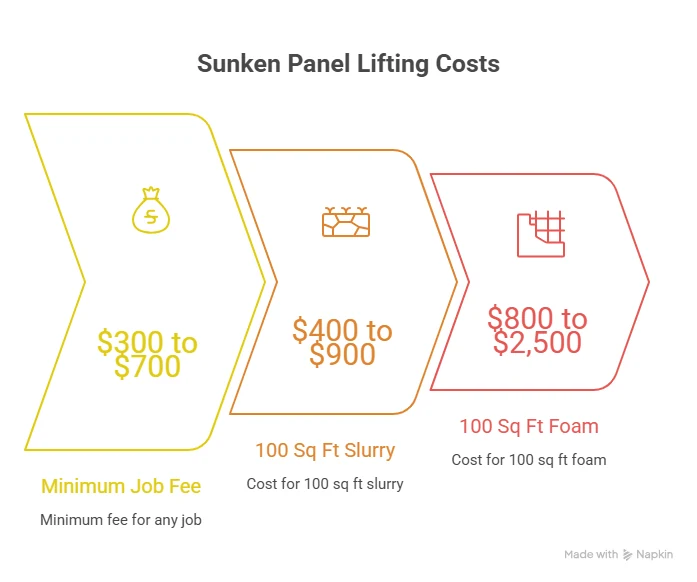
What actually applies is the minimum. Most contractors carry a minimum job fee of $300 to $700 regardless of project size, and jobs under 25 square feet often carry a trip fee on top of that. A 100 square foot run of walk, which is several panels, is quoted at $400 to $900 for slurry and $800 to $2,500 for foam.
So when somebody calls me about one panel, the first thing I ask is what else has moved. Not to upsell them. Because the answer changes their number more than anything I could do with the price.
Why one panel prices the way it does
The work does not scale down the way people expect.
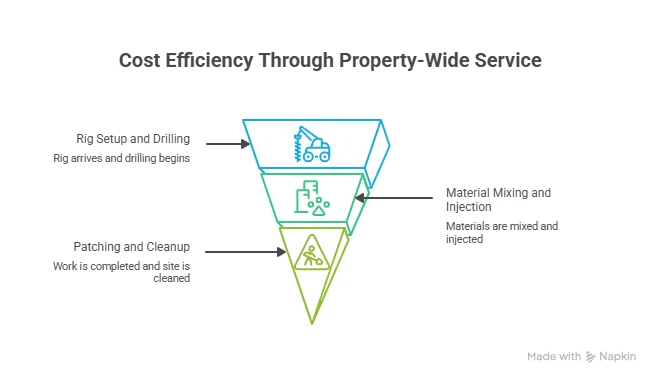
Getting a rig to the property, setting up, drilling, mixing, injecting, patching and cleaning up costs roughly the same whether we lift one panel or four. The material is a small fraction of the job. Almost everything else is fixed the moment the truck pulls up.
That is what a minimum fee is. It is not a markup on small jobs, it is the actual cost of showing up.
Which leads somewhere useful. If your walk has three faulted panels, and the garage apron has dropped, and the front stoop is sitting low, that is one visit and one minimum instead of four. The per panel number falls hard. I tell people to walk the whole property before they book anything, because the second panel is always cheaper than the first one.
Lifting or replacing that panel
Published figures put a new sidewalk at $7 to $17 per square foot installed. Removing and replacing an existing one is quoted at $10 to $25 or more, by the same publisher on the same page.
The difference between those two numbers is the old concrete leaving your property. Removal and disposal runs $3 to $8 per square foot on its own, and taking out a 50 foot walk runs $750 to $1,250 before anybody pours anything.
Add a permit at $50 to $100. Confirming what your project needs is your responsibility as the property owner, not something we file for you, and it is worth a call to the city before work starts.
I have never once seen those numbers come out in favor of tearing up a panel that only sank. Set that against a lift on a sound panel and the arithmetic is not close. If you are working out whether it is worth lifting at all, that question comes first.
What Omaha's code decides for you
This is the part that turns a cheap repair into an expensive one, and most people meet it in the form of a notice.
Under Omaha Municipal Code sections 26-41 through 26-44, the property owner is responsible for repairing the sidewalk abutting their property. The city publishes the thresholds that make a walk defective:
- Faulted at a joint or crack with 1 inch or more of deflection.
- Raised or sunken more than 2 inches in 8 feet from the normal profile line.
- Cracked into three or more pieces per panel.
- Any single crack with a half inch or greater opening.
- Cracking with spalling deeper than 3/8 inch.
I read that list as a budget document, because that is what it is. The first two are settlement, and settlement lifts. The last three are condition, and condition does not. The same list that tells you the city cares also tells you which side of the line your panel is on.
If you do not act, the city's contractor performs the work and bills you, with 30 days from the billing date to pay. At that point you are not choosing between a lift and a replacement. You are receiving an invoice for the replacement.
Responsibility varies and we are not attorneys. Confirm your own obligation with the city before you spend anything.
Where the half inch figure comes from, and what it does not mean
You will see a half inch quoted as the point where a lip becomes a hazard. It is worth knowing where that comes from.
Federal accessibility standards allow a quarter inch of vertical change with no treatment, up to a half inch if it is beveled, and anything more has to be treated as a ramp. Those standards, including the public right-of-way guidelines, apply to facilities built or altered by state and local governments.
They are not a rule you personally have to meet on your own walk. What they are is a useful measure, drawn by people who study how pedestrians fall, of when a lip stops being cosmetic. It sits at roughly half the movement Omaha would call defective.
I use the half inch as my own threshold regardless of who it legally binds. By the time a panel is 1 inch out and the city is interested, somebody has been catching a toe on it for a couple of years.
When lifting is not an option
The code's own condition thresholds do this work. Three or more pieces per panel, a half inch crack opening, spalling deeper than 3/8 inch. Any of those and no lifting price applies, because lifting is not the repair.
Raising a slab restores its position. It does not restore concrete that is worn out.
I turn down walks on that basis regularly. It costs me the job and it saves somebody from paying for a level panel with a failed surface, and I would rather have that conversation at the estimate. If the panel is sound and you are wondering how long the repair lasts, that is a fair question with an honest answer.
Getting a number for your walk
A sidewalk quote is per panel and per visit, so the estimate is somebody counting what has actually moved and checking whether each piece is still liftable.
I walk it with you, tell you which panels are settlement and which are condition, and give you a number for doing them together rather than one at a time. I will also tell you what I expect out of the repair, because a lift lasts as long as the conditions under the slab allow, and your soil is part of the quote whether anybody says so or not.
Free, on site, no obligation, and same-day response is typical. Call or text (402) 625-4920.
We cover Omaha, Bellevue, Papillion, La Vista, Ralston, Council Bluffs, Gretna and Bennington for sidewalk leveling, and the full pricing picture across every surface is in what leveling costs per square foot.
FAQ
How much does it cost to fix a sunken sidewalk?
Usually $300 to $900 for a single settled panel, because most contractors carry a minimum job fee of $300 to $700 regardless of size. Larger runs price closer to the per square foot rate, roughly $4 to $9 for slurry and $8 to $25 for foam. Doing several panels in one visit lowers the cost per panel considerably.
Is it cheaper to lift a sidewalk panel or replace it?
On a sound panel that has settled, lifting is cheaper and it is not close. Replacement means removal at $3 to $8 per square foot plus a new pour at $7 to $17, plus a permit. Lifting skips the removal entirely. On a panel that is broken or spalling, replacement is the only real option at any price.
Who is responsible for repairing a sidewalk in Omaha?
Omaha Municipal Code sections 26-41 through 26-44 place responsibility for the abutting sidewalk on the property owner, and the city publishes specific defect thresholds. If an owner does not act on a notice, the city's contractor performs the work and bills the owner, with 30 days to pay. We are not attorneys, so confirm your own situation with the city.
When is a sidewalk too damaged to lift?
When the damage is condition rather than position. The city's own list is a good guide: three or more pieces per panel, a single crack with a half inch or greater opening, or spalling deeper than 3/8 inch. A panel that has simply dropped or faulted at a joint is still a lifting candidate.
How much does one sidewalk panel cost to level?
Expect the minimum job fee to be most of the bill on a single panel, so $300 to $700 plus a possible trip charge on very small jobs. That is why the per panel cost drops sharply when several are done together. Ask for the quote both ways, one panel and all of them, before deciding.