
Almost every page answering this question was written by somebody who only sells one of the two methods. That is worth knowing before you read any of them, including this one.
We run both. So the honest answer is that they solve the same problem differently, and the slab decides which one fits. There are four things I look at to sort it, and the first one settles most jobs before I get to the second.
The short answer
Neither one is better. They trade against each other.
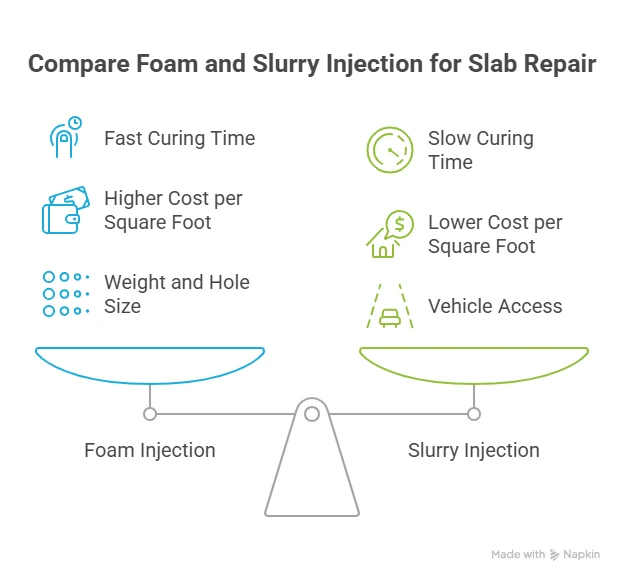
Foam is lighter, cures in minutes, and leaves smaller holes. It costs roughly double per square foot.
Slurry costs less, fills a void thoroughly on a base that is still solid, and does it with material that weighs a great deal more, through holes you will see up close.
When somebody calls and asks which one they should get, I tell them I cannot answer that on the phone, and that is not me being cagey. The answer depends on what is under their concrete, and that is the one thing neither of us can see from where we are standing.
What each one actually is
Mudjacking, also called slabjacking or slurry jacking, drills holes through the slab and pumps a cement based mix underneath it. The material flows into the void, fills it, and the pressure lifts the concrete back to position.
Polyurethane foam, also called polyjacking, drills much smaller holes and injects a two-part liquid. The two parts react, the foam expands, and that expansion does the lifting while it cures.
That difference in how the material moves has a consequence worth knowing. A state transportation study comparing the two found that grout fills voids only near the injection hole, where the foam travels further from where it went in, and that fewer and smaller holes reduce the chance of weakening the slab.
Whichever material is going in, the part I am actually doing is watching. The slab comes up against a level reference and I stop it at the right height, not the highest height I can reach. Concrete that goes up too fast, or too far, cracks.
Side by side
Every physical row below comes from a state research report or the ready-mix industry, not from either method's marketing.
| Mudjacking | Polyurethane foam | |
|---|---|---|
| Material | Cement based slurry | Expanding two-part foam |
| Injection hole | 2 to 3 inches | About 5/8 inch |
| Weight of material | 140 to 150 lb per cubic foot | Roughly 4 to 6 lb per cubic foot |
| Back in service | About a day before vehicles | About 15 minutes |
| Cost per square foot | $4 to $9 | $8 to $25 |
| Published lifespan | 5 to 10 years or longer | 10 to 15 years or longer |
| Void filling | Concentrated near the hole | Travels further from the hole |
| Real drawback | Weight, and patch size | Cost, and the rate climbs on small jobs |
Hole diameters and the material behaviour come from the Oregon DOT study, which measured both. Concrete density is the ready-mix industry figure for normal-weight concrete. Foam density is what that same study measured in its own samples.
One row on that table decides jobs by itself, and it is not the price row. I have turned down foam work and turned down slurry work on the strength of that one line, and I will explain which line it is next.
The sorting rule: four questions
What will the base carry?
Put the two weight figures next to each other. Normal-weight concrete runs 140 to 150 lb per cubic foot. The foam samples in that study measured under 7 lb per cubic foot. That is roughly 25 times the mass going in underneath your slab.
On a solid base, that extra weight is nothing to worry about and you have bought yourself a cheaper repair. On a base that is soft, saturated or already washed out, you are adding load to ground that has just demonstrated it cannot carry what is already there.
Spring makes this worse. When frozen ground thaws, the subgrade loses bearing capacity, and refreezing after a thaw leaves it looser than it started. April is when most people call me, and April is when the ground under their slab is least able to take more weight.
This question answers most jobs on its own.
How fast does it have to go back in service?
Foam reaches 90% strength within 15 minutes of injection, which is why highway crews use it and reopen the lane the same afternoon. Slurry wants roughly a day before you park on it.
Whether that matters is entirely about your property. Two cars, no street parking, a driveway you need tomorrow morning: it matters a lot. A back patio nobody walks on until Saturday: it does not matter at all, and paying for speed you will not use is just paying more.
How much do the patches matter?
Foam holes are about 5/8 inch. Slurry holes are 2 to 3 inches. On a front walk or a stoop people look at every day, that is a real difference.
The honest part: neither is invisible. The ports get patched, and the patches are visible up close and blend over time. Anybody telling you foam leaves no mark is selling. It leaves a smaller mark.
What does it cost?
Roughly double per square foot, foam over slurry, and that gap behaves strangely at the small end. Most contractors carry a minimum of $300 to $700 regardless of size, and jobs under 25 square feet often carry a trip minimum on top.
So on a 40 square foot stoop, the minimum is most of the bill either way and the method barely moves the number. On a 600 square foot driveway, the method is the number. Small job, pick on the other three questions. Big job, the cost question earns its place.
Surface by surface
Here is where the four questions usually land, with the reason attached rather than a bare recommendation.
| Surface | Usual call | Why |
|---|---|---|
| Driveway and apron | Often slurry | Base is usually solid, weight is not a concern, area makes cost matter |
| Sidewalk | Either, precision leans foam | The lift has to stop at an exact height |
| Patio | Either | Sits on backfill, but rarely carries load |
| Garage floor | Foam | Base is usually already soft, and vehicles come back the same day |
| Pool deck | Foam only | No slurry weight next to the shell |
| Steps and stoops | Usually slurry | Small area, minimums dominate, weight is irrelevant |
The pool deck row is the only one of those I will state as a rule rather than a tendency.
A homeowner in West Omaha had deck sections settling toward the pool, so water, chemicals and grit were running straight in. He had paid twice to recaulk the coping and the caulk kept failing. It was failing because the slab was moving, not because the caulk was bad.
The subgrade near the shell was soft, which took slurry off the table before I had finished walking it. Foam, small holes, incremental lift, watching the joint at the coping the whole way up. We cleaned and resealed the expansion joints as part of the work, because open joints beside a pool deck are how the washout started. It cured the same afternoon and the deck drains away from the pool now.
What each one does badly
Mudjacking. Bigger patches you will see. Meaningful weight added to the base. Roughly a day before vehicles. On a soft subgrade it is the wrong tool, and I will say so.
Polyurethane foam. Costs about double per square foot. On small jobs the per-foot rate climbs hard, because the minimum swallows the job. And it is not permanent, whatever anybody tells you.
Why foam gets recommended more than it needs to be
I will say the unpopular thing.
Foam carries better margins and it sounds newer, so it gets recommended on jobs that do not need it. That is not usually dishonesty, it is a contractor who bought a foam rig and now has one answer available. Some companies only offer one method, which makes the recommendation easy to predict.
On exterior flatwork sitting on a base that is still solid, slurry fills a void for less of your money and it has a long record in Midwest freeze and thaw. The weight argument against it is a real argument in exactly three situations: garage floors, pool decks, and a subgrade already too soft to carry more load.
Two methods, and they are not the same thing dressed up differently. I pick the one that fits the job, and sometimes the one that fits is the cheaper one.
The thing neither method changes
This is the part I would want to read if I were the one hiring.
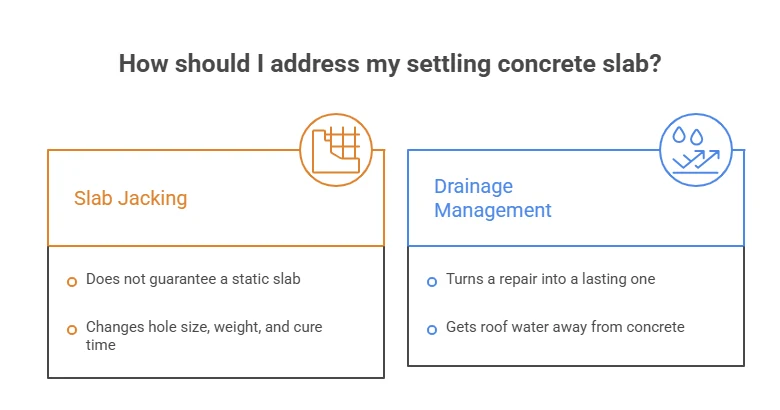
That Oregon study did not stop at the injection. It tracked the slabs afterward, and they still settled, up to 0.413 inch over two years. The report's conclusion is blunt: slab jacking, regardless of method, does not guarantee a static slab.
Read that against the four questions above. The method changes the hole size, the weight, the cure time and the price. It does not change what is underneath. A lift lasts as long as the conditions under the slab allow, and the conditions are set by where the water goes, not by what we pumped in.
Which is why the cheapest thing on your estimate is usually the most important. Get the roof water away from the concrete. Federal guidance puts downspout discharge at least 5 feet from the foundation, or an underground catchment at least 10 feet out, with lateral pipe pitched at 5/8 inch per foot or steeper. Reseal the joints so water stops running down them.
I point that out at every estimate whether or not it is work I am getting paid for. Dealing with the water source is what turns a repair into a lasting one, and if the drainage is not changing I would rather say so before you spend anything than stand on the same slab with you in three years.
What neither method fixes
Raising a slab restores its position. It does not restore concrete that is worn out.
If the surface is flaking, pitting or shedding grit with no change in height, that is a surface problem the ready-mix industry calls scaling, peeling of the finished surface from freezing and thawing, driven by too little entrained air in the original mix, heavy de-icer on concrete that was not cured properly, or finishing while bleed water was still sitting on it. Surface problem, surface answer. Lifting it gives you a level slab with the same bad surface.
Same for a panel broken into several pieces, which has stopped acting like a slab. Same for an active growing root, which will move it again on the root's schedule. I turn down a fair number of calls on those three things, and I would rather do that at the estimate than take the money and watch it fail. If you are trying to work out whether your concrete is worth lifting at all, that is a different question and we laid it out in whether the slab is worth lifting.
What it costs, briefly
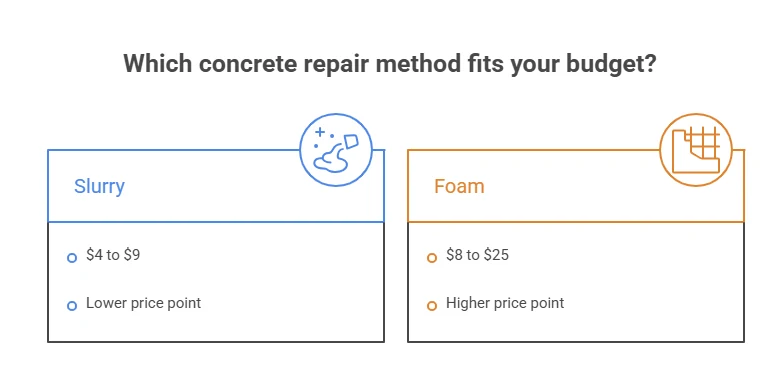
Slurry runs $4 to $9 per square foot and foam $8 to $25, against $6 to $15 per square foot for a replacement pour before removal is added. Those are market ranges, not our quote.
The full grid, by method and by slab, is in what each one costs. I quote the method after walking the slab, never before, because until I know what the base will carry I do not know which method I am quoting.
Getting the method chosen for your slab
The estimate is where those four questions get answered. We walk the concrete together, I check what the base will carry and how far it has to come up, and the method follows from that rather than from what is on the truck.
If the answer is that the water has to be dealt with first, you will hear that before you hear a price. If the answer is that the slab is past lifting, you will hear that too.
Free, on site, no obligation, and same-day response is typical. Call or text (402) 625-4920.
We cover Omaha, Bellevue, Papillion, La Vista, Ralston, Council Bluffs, Gretna and Bennington.
FAQ
Is mudjacking or polyurethane foam better?
Neither. Foam is lighter, cures in about 15 minutes and leaves smaller holes, and costs roughly double per square foot. Slurry costs less and fills a void thoroughly on a solid base, with more weight and bigger patches. The right one depends on what the base will carry, how fast you need the surface back, how visible the patches are, and the size of the job.
How long does polyurethane foam take to cure?
Research on injected polyurethane found it reaches about 90% of full compressive strength within 15 minutes, which is why road crews reopen lanes the same day. On a residential driveway that means vehicles the same afternoon. Slurry wants roughly a day before vehicle weight.
Will the injection holes be visible after the repair?
Yes, up close. Foam holes are about 5/8 inch and slurry holes are 2 to 3 inches, and both get patched. The patches are visible close up and blend over time. Anybody promising an invisible repair is overselling it.
Is foam worth the extra cost?
On a garage floor, a pool deck or any soft subgrade, yes, because weight is the deciding factor and slurry is the wrong tool there. On exterior flatwork over a solid base with no hurry to get back on it, often not, and the money is better spent on the drainage that caused the problem.
Does concrete lifting work in Nebraska winters?
Foam handles cold better than slurry. The larger complication is frozen ground, because a slab sitting high on frost is not sitting where it will sit in April, which makes an accurate diagnosis harder. We will say honestly when waiting for a thaw would give a better result.
How long will the repair last?
Published lifespans put slurry at 5 to 10 years or longer and foam at 10 to 15 or longer, both depending on soil and drainage. A field study that tracked injected slabs for two years found they still moved, and concluded that slab jacking of either kind does not guarantee a static slab. A lift lasts as long as the conditions under the slab allow, which is why the water source matters more than the method.