
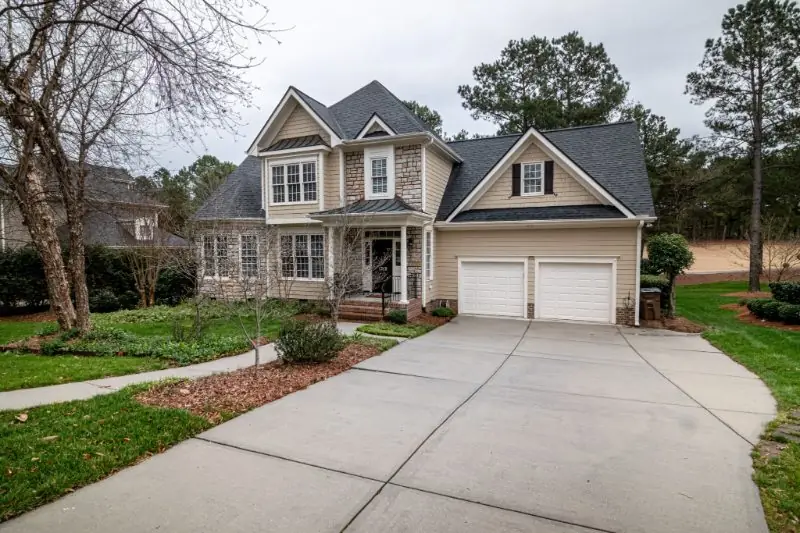
You searched driveway, so the number in your head is a driveway number.
It is probably for the wrong thing. In 20 years of walking these, I can count on one hand the people who needed the whole driveway lifted. What they needed was one panel, sometimes two, and that is a different conversation about money.
You are pricing panels, not a driveway
Walk out and look at the joints. They are not decoration.
Flatwork gets jointed so that cracking happens where somebody chose rather than where the slab decides. Published industry guidance puts maximum joint spacing at 24 to 36 times the slab thickness, which is roughly 10 feet on a 4 inch slab, with a recommended cap of 15 feet. That is why your driveway is divided the way it is.
Each of those panels sits on its own ground and moves on its own schedule. So when somebody asks me what a driveway costs, my first question back is how many panels are low.
Go and count. Put a straightedge or a level across each joint and see which side has dropped. Most people come back and tell me one, occasionally two. I have quoted a lot of driveways and I have lifted very few of them entire.
Why the apron goes first
There is a reason it is almost always the panel at the garage.
That one sits on backfill, the loosest ground anywhere on the property, and it is usually a separate pour from both the house and the rest of the drive. It drops first, it drops furthest, and when it does it reverses the slope at the door and starts sending water inside.
That is a settlement story rather than a pricing one, and I have written it up properly in why slabs sink. For the money question all you need is the consequence: the piece that moved is small, so the job is small.
What the numbers actually look like
Here is enough to do your own arithmetic before I ever turn up.
Published 2026 cost data puts a standard one-car driveway at 200 to 288 square feet, a two-car at 400 to 576, and a three-car at 864 to 900. Find yours on that list or measure it.
Then the rate. Lifting runs $4 to $9 per square foot with cement slurry and $8 to $25 with polyurethane foam.
Now the part that changes the answer. You are not buying the whole area. A garage apron is one panel, so on a two-car driveway you are usually buying 60 to 150 square feet of work rather than 400. Multiply that by the rate and you get a number most people find considerably smaller than the one they arrived with.
Where the method choice starts to cost real money
This is the first job on this blog where slurry against foam is a financial decision.
On one sidewalk panel it is not. Minimum job fees in this trade run $300 to $700 regardless of size, and jobs under 25 square feet can pick up a trip fee on top. The minimum swallows the difference between methods, so you choose on technical grounds and the price barely notices.
A driveway is past all of that. At 150 square feet, let alone 400, a method costing roughly double per square foot costs you roughly double. Full stop.
I still pick the method by what the base will carry, not by what it costs. But on a job this size I tell people the two numbers, because it is their money and the gap is no longer academic. If you want the full sort by method and surface, it is in what leveling costs.
Lifting against replacing, on a slab this size
A new concrete driveway is published at $6 to $15 per square foot installed, with a two-car coming in at $2,400 to $8,600 total.
Removal is quoted two ways, and the spread confuses people. The same research puts removal at $2 to $6 per square foot when it is bundled into a replacement, while standalone removal runs $3 to $8. Same work, different invoice. A crew already mobilized to pour is cheaper than one coming out only to demolish.
Set either against lifting one or two sound panels and it is not close. I have never seen that comparison come out the other way on concrete that is still good, and that condition is the next section.
What moves the number on your driveway
Four things, and you can assess three of them yourself.
Panel count. You now know how to get it.
Depth of drop. A panel an inch low takes less material than one sitting 3 inches low, and more material means more money.
Access. This one usually works in your favor. A driveway is the easiest thing on any property to get a rig to, which is the opposite of a back patio behind a gate.
The street end. If the apron at the curb is out of level and pushing water toward the street, that is work in the public right of way, and the city has a drive approach and curb cut permit covering it. Confirming what your project needs is your responsibility as the owner rather than something I file for you. We are not attorneys, so make the call before anybody starts.
When a driveway is not a lifting job
Long runs fail differently from single slabs.
If panels have broken into several pieces along the drive, there is nothing coherent left to push on. A transportation study found grout generally fills voids only near the injection hole, and industry guidelines say forcing material into unsupported ground ends in cracking. Both of those get likelier the longer the run.
If the surface is flaking, pitting and shedding grit with no change in height, that is scaling, from freeze and thaw on concrete with too little entrained air, heavy de-icer, or finishing over bleed water. Raising a slab restores its position. It does not restore concrete that is worn out.
I turn down driveways on both counts, and I would rather do it at the estimate. Whether yours qualifies at all is a separate check worth doing first.
Making it last
Spend a little at the garage end and the repair holds far better.
Federal building guidance puts downspout discharge at least 5 feet from the foundation, or an underground catchment at least 10 feet out with lateral pipe pitched 5/8 inch per foot or steeper. On a driveway the one to watch is the downspout nearest the garage corner, because that is the water reaching the panel that already moved.
Reseal the joint between the apron and the garage slab as well. I point that out at every driveway estimate whether or not it is work I am paid for. A lift lasts as long as the conditions under the slab allow, and the agencies that do this at scale treat slab stabilization as maintenance with a service life rather than a repair that ends.
Getting a number for yours
When I walk a driveway I count panels, check each joint with a straightedge, and tell you which ones are settlement and which are condition. Then you get a number for doing the ones that moved, and a number for doing the lot, because those are different decisions and you should see both.
Most of the time the first number surprises people, and the surprise runs the right way.
Free, on site, no obligation, and same day response is typical. Call or text (402) 625-4920. We cover Omaha, Bellevue, Papillion, La Vista, Ralston, Council Bluffs, Gretna and Bennington for driveway leveling.
FAQ
How much does it cost to lift a sunken driveway?
It depends on how much of it sank, which is usually far less than people expect. Published 2026 rates run $4 to $9 per square foot for cement slurry and $8 to $25 for polyurethane foam, applied to the panels that actually moved rather than the whole driveway. A single settled apron panel is commonly 60 to 150 square feet of work. Count your low panels before you assume a number.
Is it cheaper to lift a driveway or replace it?
On sound concrete, lifting wins and it is not close. A new driveway is published at $6 to $15 per square foot installed, or $2,400 to $8,600 for a typical two-car, and removal adds $2 to $6 per square foot bundled or $3 to $8 on its own. Lifting a panel or two skips all of that. On a driveway whose panels have broken up, replacement becomes the only real option at any price.
Can just the garage apron be lifted?
Yes, and that is the most common driveway job there is. The apron is usually a separate pour on backfill, so it settles on its own and can be raised on its own. Lifting it back to positive grade is also what stops water running toward the garage door, which is how most people notice the problem in the first place.
How long does driveway leveling last?
Published figures put slurry at roughly 5 to 10 years and foam at 10 to 15, both conditional on soil and drainage. Transportation agencies treat this work as a maintenance treatment with a service life rather than a permanent repair. A lift lasts as long as the conditions under the slab allow, so the downspout at the garage corner matters more than the method.
Do I need a permit to fix my driveway in Omaha?
For work inside your property line, usually not, though rules vary and it is worth checking. The part that changes the answer is the approach at the street, because that sits in the public right of way and the city runs a drive approach and curb cut permit covering it. We are not attorneys, so confirm your own situation with the city before any work starts.