
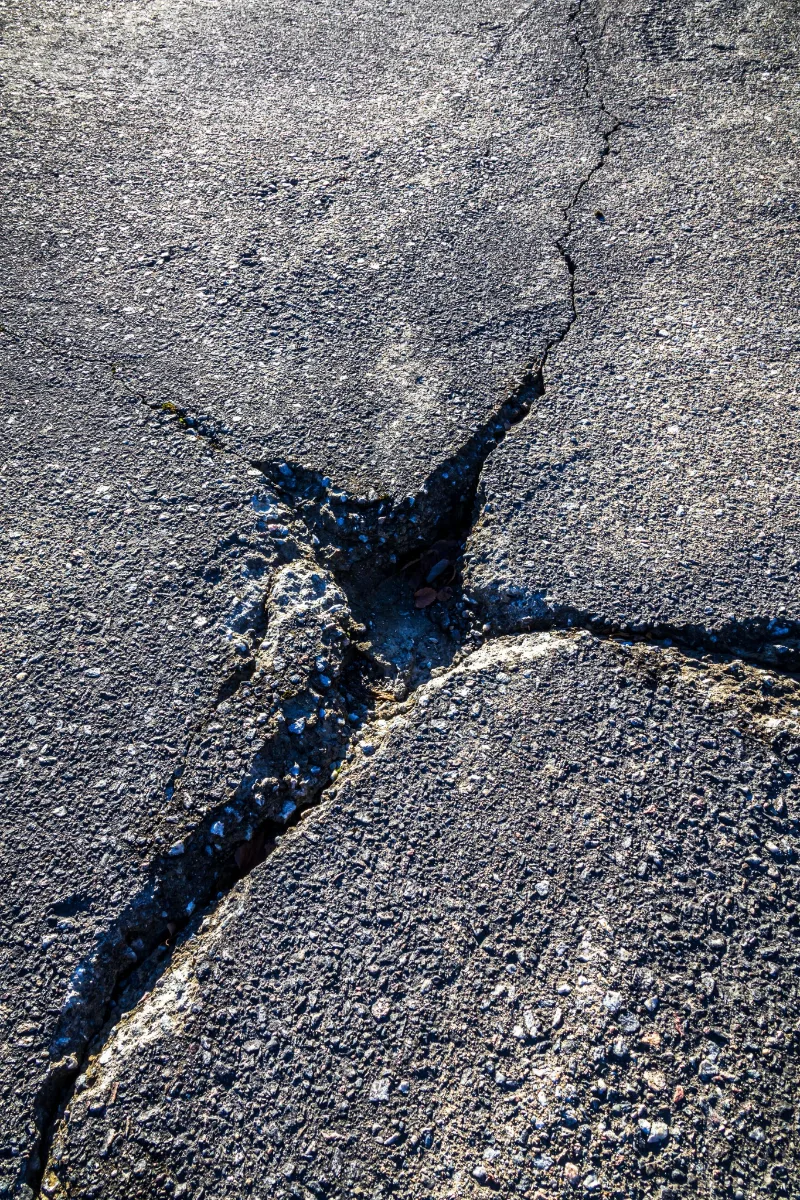
Concrete does not sink. The ground under it moves, and the slab goes along with it. That sounds like a technicality until you realise it changes the whole question, because there are four ways the ground moves and they do not all behave the same afterwards.
Two of them are largely finished once we correct them. Two of them will do it again unless something else gets dealt with first. Knowing which one is under your slab is the difference between a repair that holds and a repair that buys you two seasons.
The short answer: four mechanisms, one accelerator
Here they are, named, before anything else.
Fill consolidation. The ground your flatwork sits on was put back by a machine and it is still settling. Erosion and washout. Water has carried the fine material out from underneath and left a void. Clay shrink and swell. The soil itself changes volume with moisture and the slab rides it. Roots and poor compaction. Something growing underneath, or a base that was never right.
Then the thing that runs through all four. Water is almost always involved. It is not usually the sole cause, it is the accelerator, and it is the only part of the equation a homeowner can change.
When I walk up to a settled slab I am not really looking at the concrete. I am looking for which of those four it is, and I can usually tell in the first two minutes from where the water has been running and what has separated from what.
Symptom to cause: what you can read from above
You can do most of this yourself before anybody comes out.
| What you see | Most likely mechanism |
|---|---|
| Slab dropped away from the house, a door or the garage floor | Fill consolidation |
| One corner low, worst near a downspout or a hose bib | Erosion and washout |
| Movement that changes between a wet spring and a dry August | Clay shrink and swell |
| A hump or a lifted edge near a mature tree | Roots |
| Uniform drop across a whole slab with nothing separated | Poor original compaction |
| A lift in winter that partly reverses in spring | Frost action |
| Surface flaking or pitting with no change in height | Not settlement |
The trick I use most is the reference point. Settlement is only visible because something beside it stayed put. Find the thing that did not move, the door threshold, the garage floor, the foundation wall, and measure from that. If nothing has separated from anything, you are probably not looking at settlement.
Mechanism one: the ground was never solid to begin with
Your house sits on footings placed below the frost line, roughly 3.5 feet down in this area. Your patio, your stoop, your garage floor and your driveway apron do not. They sit on backfill, which is the loosest ground on the property, and backfill keeps compacting for years after somebody smoothed it over.
The house stays put. The patio drops. That is not a mystery, it is just how it was built.
Telltale: separation from something fixed. A gap at the house wall, a step down at the garage door, a stoop sitting below the threshold it used to meet.
Recurrence: low. Consolidation is largely a one-time process, and once the void is filled properly that ground is doing what it was always going to do, only now it is supported.
This is the mechanism I am happiest to find, because the repair does what people hope repairs do.
Mechanism two: water took the base away
Water moves the fine material out from under a slab and you end up with a void. Once there is a void, the slab has nothing left to sit on. A downspout emptying beside a driveway, a sump line running under a walk, a joint that opened up and nobody resealed, a hose bib that drips all summer, a grade that runs the wrong way. Any of those, given a few years.
Telltale: the low point follows the water, not the shape of the slab. If the corner nearest the downspout is the corner that dropped, you have your answer.
Recurrence: high, and unavoidable, unless the water source gets dealt with. This is the mechanism that gives lifting a bad name, because a perfectly good lift over a live water source will move again and the customer blames the repair.
I got called to a garage a while back where a homeowner could not work out why water was getting in. He had checked the door seal. He had checked the foundation. He had checked the downspouts. Nothing.
The apron had dropped. Not dramatically, and not quickly, which is why nobody caught it. It had gone gradually enough that the slope reversed without anyone noticing, and once it did, every rain ran toward the garage floor instead of away from it. We foamed the apron back to positive grade and it stayed dry through the next storm. He told me it was the first time in two seasons he had not needed the shop vac after a rain.
That is what this mechanism does. It hides. The slab moves half an inch over four years and the symptom shows up somewhere else entirely.
Mechanism three: the clay itself moves
Expansive clay does not sit still. It takes on water and swells, it dries out and shrinks, and anything sitting on top of it goes along for the ride.
The numbers are worth seeing. A state geological survey puts it at up to 20% expansion by volume when clay is exposed to water, producing pressures of 20,000 pounds per square foot or greater against foundations, slabs and other confining structures. The documented damage it lists is not only foundations, it specifically names cracked driveways, sidewalks and basement floors.
The other direction is just as real. As clay and fine-particle soils dry they shrink, and extension guidance from the Northern Plains puts it plainly: the support is removed as the soil shrinks. That same guidance recommends watering evenly around a building during a long dry spell, applying water 1 to 2 feet away from the wall, and it carries a warning most homeowners have never heard. Do not fill the crack that opens up next to the wall with soil, because when it rewets and expands it can damage the wall.
Those figures describe how expansive clay behaves generally. They are not measurements of the ground under your house.
Telltale: movement that changes with the season rather than getting steadily worse. Doors and gaps that are different in May than they are in August.
Recurrence: cyclical by nature. This one is managed rather than cured, and it is managed by keeping soil moisture even rather than letting it swing.
I see this one most on the older lots where the trees are big and the ground under a walk goes from saturated in April to bone dry by the middle of August. Nothing is broken. The ground is just breathing.
Mechanism four: roots, and the compaction nobody watched
People assume roots crack concrete by brute force. Mostly they do not. Extension guidance is clear that roots are opportunistic and grow where it is easiest to grow, exploiting a breach or a crack in search of moisture rather than breaking through solid material. Roots normally run horizontally and fairly shallow, but they will go down through loose backfill.
Read that again with the first mechanism in mind. Loose backfill is exactly what your patio, stoop and apron are sitting on. The root is not attacking the slab, it is following the easiest ground on the property, and the slab happens to be on top of it.
Poor original compaction is the quieter cousin. A base that was never brought up properly settles evenly, with nothing separating from anything, which is why it is the hardest one to spot from above.
Telltale: a hump or a lifted edge near a mature tree for roots, or a whole slab that dropped uniformly for compaction.
Recurrence: with a root that is still growing, certain. That is why I will not lift over one. Raising a slab that a live root is going to move again is scheduling my own callback and spending your money to do it.
Freeze and thaw is a multiplier, not a fifth cause
Frost action needs three conditions present at the same time: soil with enough fine particles to be frost-susceptible, temperatures cold enough to drive freezing into the ground, and available water. Remove any one of the three and the effect is eliminated or at least minimised.
When all three are present, ice lenses form and grow in the direction the heat is leaving, and the surface above them heaves. Then the thaw arrives and the subgrade becomes substantially weaker and loses bearing capacity, and refreezing after a thaw leaves the material looser than it started.
So frost does not usually create the problem on its own. It takes whichever of the four mechanisms is already running and works it, every single winter. A void that would have taken a decade to matter gets there in four.
What I see in April is rarely new. It is November's problem, opened up.
Why Omaha specifically
The metro sits on expansive clay and goes through a full freeze and thaw cycle every winter. Footings go below the frost line, roughly 3.5 feet, while every piece of flatwork on the property sits on backfill above it. That combination is why this trade exists here.
There are patterns by neighbourhood too. Dundee walks are older concrete with mature root systems working underneath. Millard and Elkhorn driveways sit on fill that is still consolidating. West Omaha patios have the same backfill problem every patio has, on newer ground.
Those are my observations from 20 years of driving this metro, not published soil measurements for Douglas County. I can usually guess the mechanism before I get out of the truck, and I am wrong often enough to still walk the slab.
What is not settlement
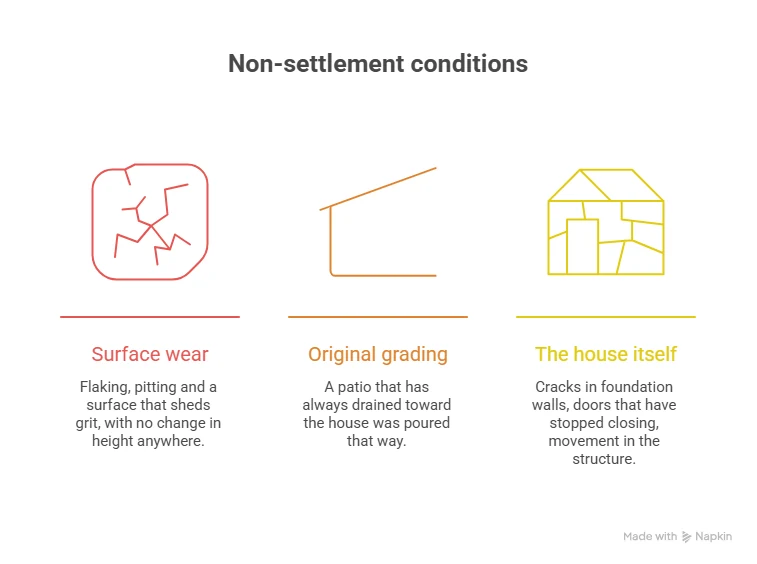
Three things arrive as settlement calls and are not.
Surface wear. Flaking, pitting and a surface that sheds grit, with no change in height anywhere. That is scaling, and the ready-mix industry defines it as peeling of the finished surface from freezing and thawing, driven by too little entrained air in the original mix, heavy de-icer on concrete that was not cured properly, or finishing while bleed water was still sitting on it. It is a surface problem with a surface answer. Lifting will give you a level slab with the same bad surface.
Original grading. A patio that has always drained toward the house did not settle. It was poured that way. Lifting can sometimes improve it, but you are correcting somebody's layout, not restoring a position.
The house itself. Cracks in foundation walls, doors that have stopped closing, movement in the structure. That is a structural engineer's call, not mine, and I will tell you that rather than guess. We lift flatwork.
If you are trying to work out whether your slab is worth lifting at all, that is a different question and we laid it out in whether it is worth lifting.
What each mechanism costs to fix, and which ones come back
Price first, briefly. Mudjacking generally runs $4 to $9 per square foot and polyurethane foam $8 to $25, against $6 to $15 per square foot for a replacement pour before removal is added. The full grid by method and by slab is in what it costs to lift.
The table that matters more on this page is not price. It is whether you are going to be paying again.
| Mechanism | The fix | Comes back? |
|---|---|---|
| Fill consolidation | Fill the void and lift | Rarely, once corrected |
| Erosion and washout | Lift, then deal with the water source | Certainly, if the water is left running |
| Clay shrink and swell | Lift, then even out soil moisture | Cyclically, managed rather than cured |
| Roots | Root dealt with first, then lift | Certainly, if the root is still growing |
| Poor compaction | Fill and lift | Sometimes, depending how deep it goes |
A lift lasts as long as the conditions under the slab allow. That is not a hedge, it is the whole point of this article. The concrete is not what decides the lifespan of the repair.
It is also why I talk about the water before I talk about the price. If the drainage is not going to change, I would rather say so at the estimate than take the job and see you again in three years.
The one variable you control
You cannot change the clay under your property. You cannot change how the fill was compacted before you owned it. You cannot stop the ground freezing in Nebraska.
You can change where the water goes, and that is one of the three legs frost stands on and the accelerator on all four mechanisms.
There are published numbers for this. Federal guidance puts downspout discharge at least 5 feet from the foundation, or into an underground catchment at least 10 feet out, with lateral pipe pitched away at a minimum of 5/8 inch per foot and buried drain pipe sloped at half an inch per foot or more for at least 10 feet.
Most of that is a Saturday and a tape measure. Extend the discharge. Reseal the joints so water stops going down them. Keep soil moisture even through a long dry August rather than letting it swing. If your patio is tipping toward the house, the joint at the wall is doing more damage than the slope is.
I point this out at every estimate whether or not it is work I am getting paid for, because the alternative is standing on the same slab in three years explaining why it moved.
Getting the mechanism identified
An estimate on settled concrete should be a diagnosis before it is a price. We walk the slab together, find which of the four mechanisms is actually running, and price the repair against that rather than against a square footage.
If the answer is that the water needs dealing with first, I will tell you that before I quote anything. If the answer is that the slab is past lifting, you will hear that from me on site rather than after you have paid.
Free, on site, no obligation, and same-day response is typical. Call or text (402) 625-4920.
We cover Omaha, Bellevue, Papillion, La Vista, Ralston, Council Bluffs, Gretna and Bennington for concrete lifting on driveways, walks, patios, garage floors, steps and pool decks.
FAQ
Why is my concrete sinking?
Almost always one of four things: fill under the slab still consolidating, water washing the base out from underneath, expansive clay swelling and shrinking with the seasons, or roots and poor original compaction. Water accelerates all four, which is why it gets blamed for everything. Which one you have decides whether a repair holds.
Will sunken concrete keep sinking?
It depends entirely on the mechanism. Fill consolidation largely finishes. Washout continues for as long as the water source runs. Clay movement is seasonal and cyclical. A growing root will keep going. A lift lasts as long as the conditions under the slab allow, so the honest answer comes from identifying the cause, not from the repair method.
Can you fix sinking concrete without replacing it?
Usually, if the slab is still sound and in one piece. Lifting fills the void and raises the concrete back to position, at a fraction of what removal and replacement costs. It does not restore concrete that is worn out, so a slab that is spalling or broken into several pieces is a replacement conversation.
Do tree roots make concrete sink?
Roots more often lift concrete than sink it, and they do it opportunistically rather than by force, following loose backfill and existing cracks toward moisture. Roots can contribute to settlement indirectly by drawing moisture out of clay soil. Either way, a slab with an active growing root under it is a poor lifting candidate until the root is dealt with.
Does freezing weather make concrete sink?
Freeze and thaw does not usually cause settlement by itself. It needs frost-susceptible soil, freezing temperatures and available water all present together, and what it mostly does is accelerate whatever is already happening under the slab. The winter lift and spring drop people notice is frost action working on a problem that was already there.
How do I stop my concrete from sinking again?
Deal with the water. Get downspout discharge well away from the slab, reseal open joints so water stops running down them, and keep the grade running away from the concrete rather than toward it. Most of that is inexpensive and you can do it yourself, and it is the single thing that most affects whether a repair lasts.