
Yes. You can. People do it, and some of them are happy with the result.
The question worth answering is the one underneath it. Pumping material under a slab is the easy half of this job. Knowing the exact moment to stop is the other half, and that is the half you are paying a contractor for.
The short answer
You can rent or buy the equipment, and nothing about the physical work is beyond a capable homeowner.
What you cannot rent is the part that decides whether it goes well. You are pumping material into a space you cannot see, under a slab that tells you nothing until it is already too late. I have been doing this for over 20 years and I still work slowly on the first port of every job, because the slab sets the pace, not me.
That is the honest frame here. It is not a strength problem or a tool problem. It is a judgment problem, and judgment does not come in the rental.
What the job actually asks of you
The tool list is short. Published guidance on the DIY route calls for a hammer drill with a diamond bit, a hydraulic slurry pump, and sometimes a circular saw with a diamond blade. The pump can often be rented.
Then there is the part that is not on any list. You mix a slurry to a consistency you have never mixed before, drill ports where you think the void is, and read the slab edge for movement measured in fractions of an inch, by eye, while holding a hose.
The same consumer guide that explains how to do it also tells you not to, if you have never worked with a concrete mixture. I did not write that line. It comes from a source with no stake in whether you call me.
The number that ends it for most people
This is where the argument usually finishes, and it finishes quietly.
Published 2026 cost data puts the DIY route at $500 to $1,200 once you total equipment rental, materials and safety gear. The same research puts a contractor's minimum charge at around $500, and a 50 square foot slab at $600 to $700 because the minimum gets spread across a small area.
Read those two numbers together. On the size of job people actually want to do themselves, you spend about the same money and keep all of the risk.
The per square foot rates disagree across sources, and I am not going to blend them into a tidy average. One puts professional mudjacking at $3 to $6, another at $4 to $9, with $8 to $25 for polyurethane foam. Those rates only start to matter on a bigger slab, and on a bigger slab the DIY case gets weaker, not stronger. The full grid by method and by surface is in what leveling costs.
Lifting it too far is the mistake with no cheap fix
I would rather show you somebody else's standard than give you my opinion here.
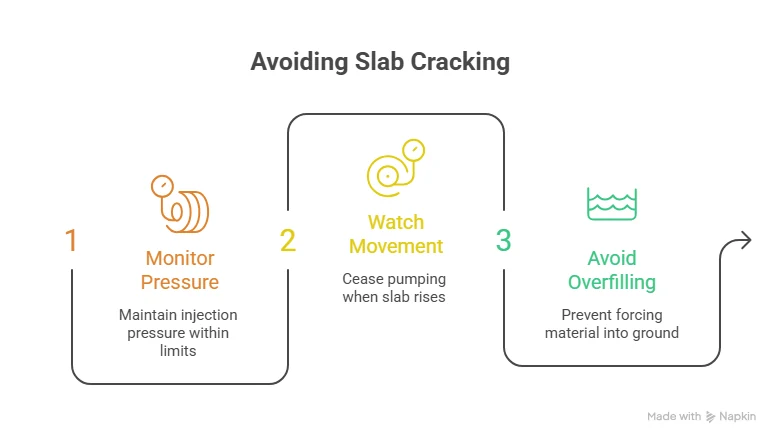
Crews doing this work on highway pavement run injection pressure at 40 to 75 psi with a ceiling of 100 psi. Their specifications limit lift to less than 0.05 to 0.10 inch. They watch dial gauges that read movement down to 0.001 inch, and the written instruction is to cease pumping the moment the slab begins to rise. Forcing material into ground that will not carry it, the guidance says, ends in slab cracking.
That is a tighter tolerance than your patio needs, and I want to be straight about it. Highway work is not residential flatwork. The point survives the translation anyway. The trade's own written standard treats knowing when to stop as the entire skill, and it does not trust a human eye to judge it. It puts instruments on the slab. Consumer guidance says the same thing in plainer words: uneven elevation can crack the concrete, and overfilling lifts it past where you wanted it.
A cracked slab is not a setback. It ends the lifting conversation and starts a replacement quote.
The foam kit route has a second problem
If you skip the slurry and buy a polyurethane kit, you have not removed the judgment problem. You have added a chemical one on top of it.
Isocyanates are, in OSHA's words, the leading attributable cause of work-related asthma. The permissible exposure limit for MDI is 0.02 ppm. Federal guidance notes that once somebody is sensitized, even low concentrations can trigger a severe asthma attack, and that manufacturers recommend medical surveillance before people work with these materials at all.
Those limits assume ventilation, protective equipment and training. A homeowner in a closed garage on a Saturday has none of that.
I am not trying to frighten anybody off. I am pointing at the one consequence of a weekend project that does not wash off afterward. Which method suits which slab is a longer conversation, and it is in slurry against foam.
Where doing it yourself is actually defensible
I am not going to pretend the answer is never, because it is not.
A small, detached, low-value slab that nobody walks on is a fair gamble. A shed pad. A stepping section at the back of the yard. Something that would not justify a minimum-fee visit anyway, where the worst outcome is that you paid for a lesson.
The line moves the moment the concrete matters. Anything attached to the house, anything carrying a car, anything beside a pool, anything holding water toward a door. And public sidewalk is its own category, because the city publishes defect thresholds and can require the work to be done properly. We are not attorneys, so confirm your own situation with the city before you touch a public walk.
The slab nobody should lift
Before anybody rents anything, check what is actually wrong. I turn down a fair number of calls on this one thing alone.
If the surface is flaking, pitting or shedding grit with no change in height, that is not settlement. The ready-mix industry calls it scaling, and it comes from freeze and thaw on concrete with too little entrained air, heavy de-icer, or finishing while bleed water was still sitting on it.
Raising a slab restores its position. It does not restore concrete that is worn out. Lifting a scaled slab gives you a level slab with the same bad surface, whoever does the lifting. If you are still deciding whether yours is worth lifting at all, that is a separate question and it comes first.
The part you should absolutely do yourself
Here is the real DIY answer, and it is the one that changes the outcome most.
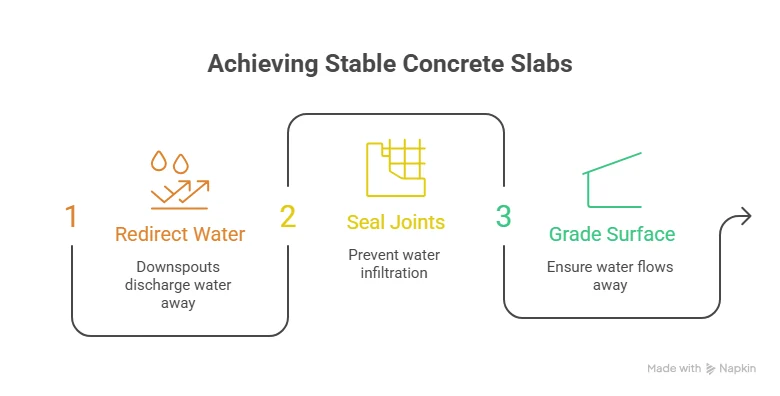
Get the water away from the concrete. Federal building guidance puts downspout discharge at least 5 feet from the foundation, or an underground catchment at least 10 feet out, with lateral pipe pitched 5/8 inch per foot or steeper. Reseal open joints so water stops running down them. Keep the grade falling away from the slab.
That work is cheap, it needs no pump, and it decides whether any lift holds. A lift lasts as long as the conditions under the slab allow, and the conditions are set by where the water goes.
Nobody gets around that, including me. Oregon's transportation department tracked injected slabs and they still moved, up to 0.413 inch over two years. Missouri's department treats slab stabilization as maintenance with a service life, not a repair that ends. Trained crews, engineered roadway, and the ground still did what the ground does.
What I would tell you on the phone
I turn down work on slabs that should not be lifted, and I would rather say so at the estimate than take the money and watch it fail in two years.
I will also say the other unpopular thing. Mudjacking gets dismissed too easily, because foam sounds newer and carries better margins. On solid subgrade, outdoors, slurry fills voids well and has a long record in Midwest freeze and thaw.
So if you have a shed pad out back and a free weekend, have at it. If it is your driveway, your garage apron, your steps or your walk, let somebody look at it first. That look is free, on site, and comes with no obligation to hire me.
Call or text (402) 625-4920. We cover Omaha, Bellevue, Papillion, La Vista, Ralston, Council Bluffs, Gretna and Bennington for mudjacking and foam lifting.
FAQ
Can you rent mudjacking equipment?
A hydraulic slurry pump can often be rented, and a hammer drill with a diamond bit is widely available. Availability varies by yard and by season, so call before you plan a weekend around it. Renting the gear is the easy part. Mixing the slurry right and reading the slab while you pump are what decide the result.
Is DIY mudjacking cheaper than hiring someone?
Usually not by much, and often not at all. Published 2026 cost data puts the DIY route at $500 to $1,200 all in, against a contractor minimum of around $500 and roughly $600 to $700 for a 50 square foot slab. The gap only opens on larger areas, where a mistake also costs more. Factor in repairing a slab you crack and the arithmetic goes the other way.
What happens if you lift a concrete slab too far?
It cracks. Highway specifications for this work limit lift to under 0.05 to 0.10 inch and use dial gauges reading to 0.001 inch, with instructions to stop pumping as soon as the slab starts to move. Overlifting also leaves unsupported gaps underneath, so the support gets worse rather than better. There is no cheap repair for a cracked slab, which is why the stopping point matters more than the lifting.
Are DIY concrete lifting foam kits safe to use?
They carry a real chemical exposure risk. OSHA identifies isocyanates as the leading attributable cause of work-related asthma and sets a permissible exposure limit of 0.02 ppm for MDI. Sensitization can be permanent, and a sensitized person can react severely to very low concentrations afterward. Those limits assume ventilation, protective equipment and training a homeowner in a garage does not have.
Is it legal to mudjack your own concrete?
On your own private slab, generally yes, though local rules vary and it is worth checking before you start. Public sidewalk is different, because the city publishes standards the finished work has to meet and can require it to be corrected. We are not attorneys, so confirm your own obligations with the city rather than taking a blog's word for it.